The jobmarket for recent graduates - not so easy

The jobmarket for recent graduates - not so easy
Higher education sounds smart. Today’s youth have probably also been told that as long as you get an education, you will get a job too, just wait and see. At least that’s how it was before. It’s probably still like that? But the job market for graduates is proving to be more difficult than it has been for a long time.
Translator: Rebekka Aasbø
Journalist: Sigve Gomnær
Photographer: Niclai Terland
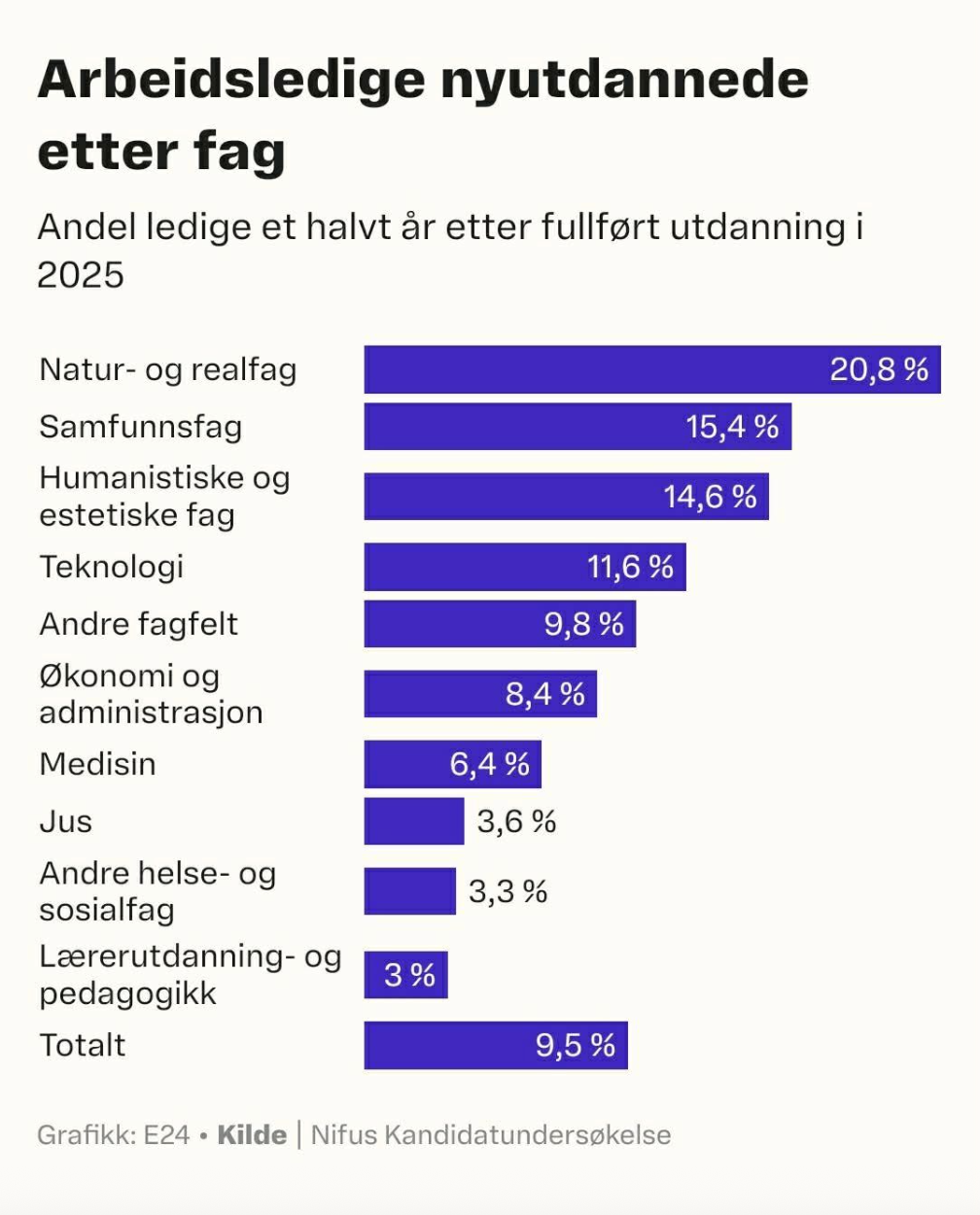
According to NIFU’s (Nordic Institute for Studies in Innovation, Research and Education) survey, unemployment among newly graduated master’s students is at a record high. Almost one in ten are completely out of work six months after completing their studies, which is the highest statistic in over 25 years. Worryingly, unemployment has increased the most among natural scientists, social scientists and economists, where nature and science students top the statistics with an unemployment rate of 20.8% six months after completing their education. Maybe not quite the numbers you want to see as an NMBU student? But that’s the way things are now. NMBU previously campaigned that they did not educate people in irrelevance. Of all the more or less relevant fields of study and subject areas one can complete, it is NMBU’s main focus areas with natural sciences that are the most irrelevant in the job market at the moment.
NMBU’s Pro-Rector for Education, Elin Kubberød, comments that they are familiar with the numbers from NIFU’s candidate survey. She expresses understanding that such notices can cause concern among students and recent graduates. Furthermore, she points out that: “the figures show that graduates from more discipline-oriented subjects, such as science and science, more often experience unemployment in the first period after graduation than graduates from professional programs.” According to Pro-Rector Elin, this is not necessarily due to a lack of relevance, but rather to the fact that the expertise is broader and can thus also be used in many different roles. Which in turn can help make the entrance to the job market more demanding.

At the same time, she points out that it is important to remember that actors such as the government and other key organisations point to a large and persistent need for science expertise in areas such as climate, energy, technology and the bioeconomy.
He believes that this also underlines the long-term relevance of these educations. So in that sense, there seems to be hope in the long run. But right here and now, newly graduated nature and science students have the most difficult conditions.
Furthermore, another question is what NMBU and other universities’ role should actually be. Should the universities’ main task be to teach subjects and knowledge in the best possible way, or to organise education so that as many students as possible enter working life quickly? There is not necessarily a definitive answer to this.
In the past, employees tended to have lower requirements for completed education among the people they employed. Former NMBU student Tord Kristian Andersen points out that “a master’s degree has now become the new bachelor’s degree in an educational context”. Something Mathilde Buttedahl, bachelor’s student in international environment and development studies, has also learned. She expects to have to take a master’s degree to get a job, as it is probably quite difficult with only a bachelor’s degree; “both because of needs, but also how narrow the market is”.

For employers, however, work experience is probably the most important thing in the search for new employees. Tord points out that “someone has to take a chance on you first”, so that as a new graduate you can gain the necessary experience. But once you get started and get a foot in the market, you achieve greater mobility and things go much easier, according to Tord. It’s simply about getting the opportunity to start. It’s as simple as that.
The job market for today’s graduates is more difficult than it has been for a long time. It is also somewhat worrying that nature and science students come out worst in the time after completing their education. NMBU, for it’s part, is familiar with the figures, but emphasizes, among other things, the long-term relevance of the studies and a broad area of expertise as positive aspects and opportunities for the future. In the long run, it is probably not so bad to have an education, but right after you finish it can be a bit convoluted. sikt er det nok ikke nødvendigvis så dumt med utdanning, men sånn rett etter man er ferdig kan det være litt kronglete.