Into the darkness n out into the world

Into the darkness and out into the world
In the heart of Ås town center lies Ås Cultural Center. Within its gray outer walls, you will find the welcoming premises of Ås Cinema. Here, residents are offered a rich selection of films in a cinema that can be described as somewhat out of the ordinary. The current cinema manager is the latest in a line of distinctive cinema directors—a line that began with the legendary cinema figure Terje Kristiansen.
Translator: Oskar Nerheim
Photographer: Nicolai Teland
Journalist: Trygve Bø Kongsbakk
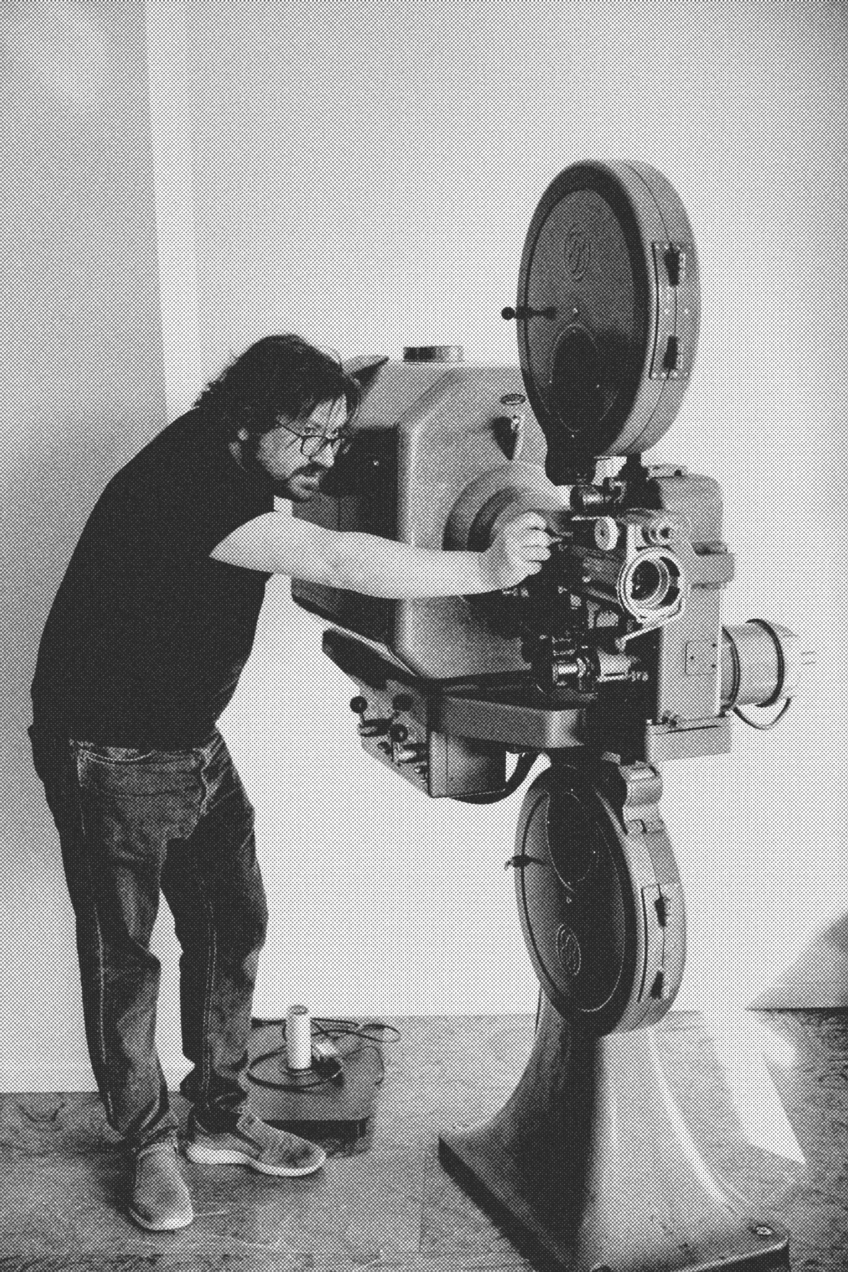
If you have visited the cinema in Ås in recent years, you have probably seen him. He is usually the one who greets you, has popped the popcorn before you arrive, sells it to you at the kiosk, and stands by the door to say goodbye when you leave. Kjetil Kvale Sørenssen is the cinema’s manager and jack-of-all-trades. Such an accessible and present cinema manager is uncommon in Norwegian cinemas today, but in Ås there is a longer tradition for it. Sørenssen tells Tuntréet that the close contact with the audience was one of the reasons he became interested in the job. Another reason was how his predecessors built up the cinema after its reopening in 2012: “as a very personal cinema with a focus on quality, and with a clear cinema manager who has a voice, has opinions, and maintains contact with the audience.”
The Different World of Ås
The cinema has 4–5 screenings a week, spread across Wednesdays and Sundays. If you are not already familiar with the cinema, a look at the program might surprise you. Despite the limited number of screenings, there is great variety in what is shown, with a significant share of films that would usually be described as niche. But if we are to believe Sørenssen, Ås is something of a different world when it comes to cinema: “Here, it is often more commercially viable to show what might seem less commercial at other cinemas. We have a very quality-conscious audience.” At the same time, he makes it clear that the Ås audience also knows how to appreciate a “good old-fashioned popcorn entertainment film.”
When Sørenssen selects films, he makes an informed guess about what will appeal to the audience, but he also tries to remain flexible: “My most attended film so far this year is Havfolket. Some other cinema managers and I assumed there might not be much audience for it due to its theme, but then we started noticing how well it performed where it was shown and the demand from customers. So we quickly adjusted and scheduled it as much as possible, and now it has done very well.” He adds that people are welcome to get in touch if there are films they would like to see screened, even though he cannot fit everything into the program.
An Ås Special
In addition to offering a wide selection of films, there is often something extra included with the screenings. Once a month there is the “Film of the Month”, where Sørenssen highlights a film he personally appreciates, with an introduction beforehand. Authors such as Erlend Loe and Hans Olav Lahlum have also visited to introduce films. Occasionally, directors of current films are invited for discussions. Sørenssen also organizes special screenings and says that the next one will be The Hunt by Erik Løchen, the grandfather of Joachim Trier. In 2011, the film was voted the best Norwegian film of all time by Rushprint. This summer, the FIFA World Cup will be shown on the big screen.

A Central Cinema in the Countryside
Ås Cinema opened in 1970. At the time, cinema manager Terje Kristiansen was given free rein in his work and became a prominent figure both in Ås and in Norway’s cultural scene. He worked actively to create engagement around the cinema. For example, he spent 85% of the budget in the first year on newspaper advertisements. The work paid off. With its varied offerings, the cinema attracted audiences from the entire surrounding region.
Kristiansen aimed to broaden people’s horizons. He established a film club and organized film seminars. He also wanted to challenge society and let the cinema serve as a platform for public debate. At Ås Cinema, there was therefore room for niche, experimental, and socially critical films.
His work made him a popular but controversial figure. He gained national attention in 1971 when he refused to screen the Norwegian film Cry, Beloved Man because he believed it was too poor in quality. The film’s director threatened to report him for defamation, but the case never went to court. That same year, the parish council filed a complaint with the municipal executive committee about the content of films being shown. They objected, among other things, to the screening of sex films and films containing violence. Kristiansen invited the municipal council to watch one of the sex films—Mazurka on the Bedside—after the meeting discussing the issue, and it was decided that he would retain full freedom over the cinema’s programming.
Decline and New Growth
For more than a decade after its opening, the cinema achieved excellent results. Its peak year was 1980, with over 120,000 visitors. After that, attendance declined, partly because it became easier and more common to watch films at home. Despite declining results, operations continued until 2005. After a seven-year break, the cinema reopened in 2012, and in 2019, under the leadership of Martin Øsmundset, it won the Hugo Award for Cinema of the Year in Norway.
Sources: Inn i Velstandsnorge – Ås 1940-2010 by Knut Dørum, Ås Avis, Østlandets Blad
Architectural Facts
The town hall complex was designed by architect Bjart Mohr, who designed several town halls and galleries. He won one of Norway’s most important architecture awards in 1983 for Holmsbu Art Gallery.
The facades of the complex mainly consist of surfaces of hand-chiseled concrete. The complex was originally designed with a five-story wing to the west facing Åsgård School, but this was never built.
The cinema foyer was renovated in 2021 with a new interior. The original floor in finely polished green serpentine stone has been preserved. New details were added, such as bamboo cladding on the columns and green velvet curtains.
Kilder: SNL, Ås Avis