The History of Pentagon - Part 1: The Past
The History of Pentagon - Part 1: The Past
Climate crisis, pandemic, and war. Even in a constantly changing world, they stand there faithfully, always ready to house an infinite number of students. I am, of course, talking about the apartment buildings of our dear student town, Pentagon. But the dormitories from the 60s show signs of wear and tear and do not fulfil the requirements for a student housing in 2022 anymore. Something is finally going to be done about this! Tender drawings are ready for the new and improved Pentagon 1! But how did this start? This is the first part of the history of Pentagon.
Journalist: Ingvild Lauvstad Sunde
The story begins
In 1948, the welfare organization law was passed. The law said that all colleges and universities in the country were obliged to create a student welfare organization. Earlier, the Student Committee of NLH had been responsible for the welfare services at the college. In 1955, the newly founded “Studentsamskipnaden i Ås” (The University Foundation for Student Life in Ås) swiftly took over these responsibilities, and on March 2nd, 1961, they announced that they “are in favor of The University Foundation for Student Life in Ås taking over all the construction and operation of the new student dormitories and apartments at the Norwegian College of Agriculture.” It happened with Halvor Holtestaul in charge, who is also known as “the man who built Pentagon”.
“Before, Thorvald lived in Circus and Tivoli by the roots of Tuntreet”
There was a big need for new housing. Before Pentagon was built, most of the students had actually lived at the attics of Cirkus and Tivoli campus buildings, “by the roots of Tuntreet”. Hankattene had also had their first Hankattloft here!
Just like Pentagon does now, Circus and Tivoli showed wear and tear by the end of its lifespan as a student housing. The student welfare organization built new houses in Kajaveien, but it still was not sufficient to accommodate the ever-growing number of students at the college. But what about building a whole “dormitory town”?
Pentagon 1, Pentagon 2 – and Pentagon 3?
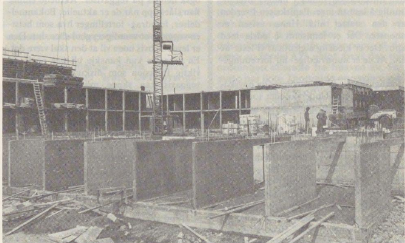
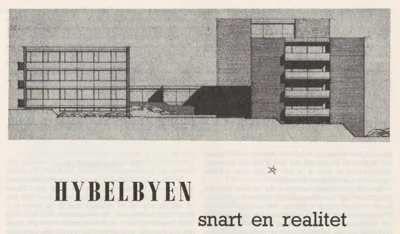
The first time the construction of the new student town was mentioned is in an article with the title “Dormitory town is soon a reality”, from an edition of Tuntreet dated March 1963. The first step in the job was for the architects’ tender drawings to be sent to The University Foundation for Student Life in Ås. Initially, the welfare organization had gotten money for 100 housings, and Arken and Børsen took up 96 of these housings together. With Casino, the number reached 150, with the welfare organization hoping to get money for those additional 50 housings a year later. The rent for the housing was 100 kroner!
The construction of Pentagon 2 was not commented on much by Tuntreet, but in the article from 1971 about the further expansion of Pentagon, it is mentioned that Pentagon 2 was commissioned into exploitation in 1967. It is here that things become a bit complicated. Pentagon 2 did not refer to today’s Pentagon 2, but to GHIJ – Grotten, Hemsen, Inferno, and Jubilo. ‘D’ and ‘E’ were planned, but never became reality.
Kringla, Løa, and Mølla therefore became “Pentagon 3”, and they stood ready for moving in in 1976. It did not take long before ABC and GHIJ became Pentagon 1, and KLM became Pentagon 2, as we know them today.
Why the name «Pentagon»?
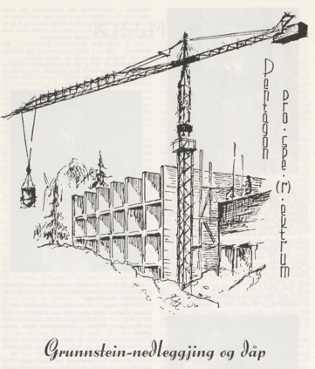
Before laying the foundation stone, the area was just called a “student town”. In Autumn of 1963, a contest was announced by the student welfare organization to find a name for the area in which the construction work had begun. A professional committee was also to review the proposed names. The wish was for the student town to get “a name that can survive so long that no one knows where it came from anymore”. Examples of name proposals were “Solbakken”, “Kilejordet”, “Kjerringhagen”, and even “Mekka”.
“Fortunately,” the choice fell on “Pentagon” and we even know where it came from! The word means “five-sided", and the name is linked to the star on the candidate ring at NMBU, which also has five sides – one for each of the original educations at NLH, namely land consolidation, agriculture, horticulture, dairy and forestry. The ring has come full circle. Or shall we maybe say the pentagon?
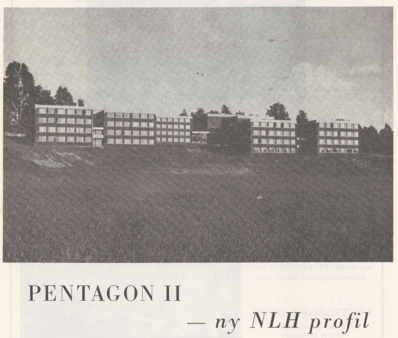
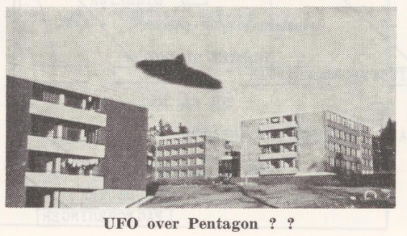
“Pentagonism” - Will the Studentsamfunnet be abandoned in favor of Pentagon?
When the name was finally chosen, another challenge appeared – what if the students become so fond of Pentagon that they stop using Studentsamfunnet? The fear for this phenomenon spread itself so much that it got its own nickname “pentagonism”. The worst-case scenario was that the students would isolate in their own dorms of six. To prevent such “pentagonism” from becoming a reality, measures were introduced in the planning of the housings.
The article from 1963 describes the common rooms at ABC. “The 150 housings shall therefore share a common room in the basement. (…) the basements [will be] used for luggage storage, ski and bicycle stables, saunas, and emergency shelters.” The fear of pentagonism is especially easy to read between the lines in descriptions of how useful these shelters are: “The shelters can also possibly be used for things such as TV rooms, hobby rooms and whatever one shall find appropriate. It can be mentioned, among other things, that there was a proposal for furnishing a prayer room/meditation room here.” The student welfare organization also suggested that the flat roofs on the blocks can be used as sun terraces, as compensation for not building attics in the blocks.
Luckily, “pentagonism” never became a reality, and one can only wonder about if SiÅs of today is as satisfied with the common rooms in the basements and the layer of solidified alcohol which has been covering the floors since 1963.
Worse conditions, but Pentagon has, after all, experienced many drunk students. An era is coming to an end. The student idyll of the 60s will be replaced in favor of the student idyll of 2022. There is no way of avoiding the fact that students demand different functions from a dormitory now than they did 60 years ago. And it actually is almost 60 years since the founding stone of ABC was put in place. The technical requirements are higher now, and there is a larger focus on sustainable and compact urban development. But with increased technical requirements, there shall also be more things to get worn out. Will Palisaden and Skogveien live for as long as the good old Pentagon? Pentagon has actually withstood the test of time, although it is time that the drunk students got themselves someplace new to live.
Despite the aging buildings and poor standards, I am citing an article about the laying the foundation stone in Pentagon: “Thorvald reveals a sincere gratitude for his Pentagon”.