TT Taboo: Artificial Intelligence
TT Taboo: Artificial Intelligence
In 2023, ChatGPT’s generative AI model became available to everyone – and overnight, it changed technology, humanity, and student life. Suddenly, we had ready-made term papers, code, and notes at our fingertips. A lot has happened in a short time, and sometimes it feels like we are test subjects in a massive technological shift. That’s why Tuntreet wanted to explore how students use AI, what we really think about it – and not least, how NMBU is handling this new technological era.
Journalist: Marie Tjelta
Translator: Rebekka Berg
How do we use AI?
Tuntréet received 58 responses to the survey. The majority of respondents (38%) use AI 2–3 times a week. Close behind, 22% admit to using it daily. Meanwhile, 8% say they never use AI. From our numbers, it’s clear that AI has become a natural part of student life.
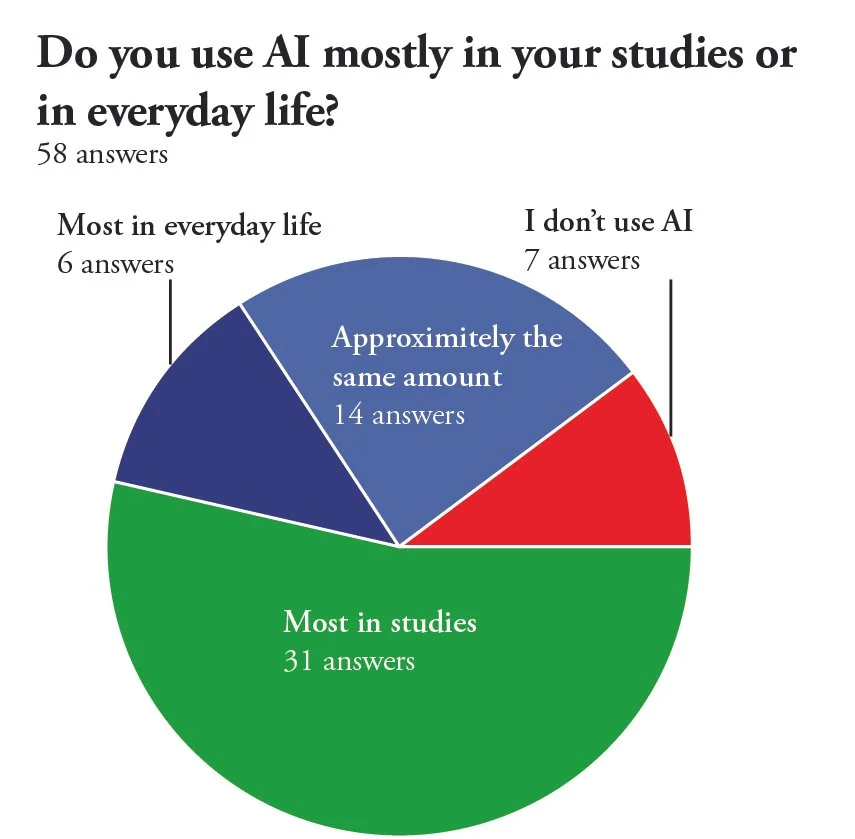
We use the technology often, but what do we use AI for the most – in our studies or daily lives? Analyses of ChatGPT’s web traffic show that usage drops significantly in May when students go on summer break, and spikes again in August–September at the start of the school year. This suggests that many primarily use AI for school, but what about NMBU students? When asked, “Do you use AI mostly for studies or daily life?”, 53% answered that they use it mostly for studies, 24% said both equally, and only 10% said they use it mostly in daily life. On the question of specific use cases, the top three were clear:
1. Summarizing and explaining academic material
2. Writing assistance
3. Everyday help
AI in the grey zone
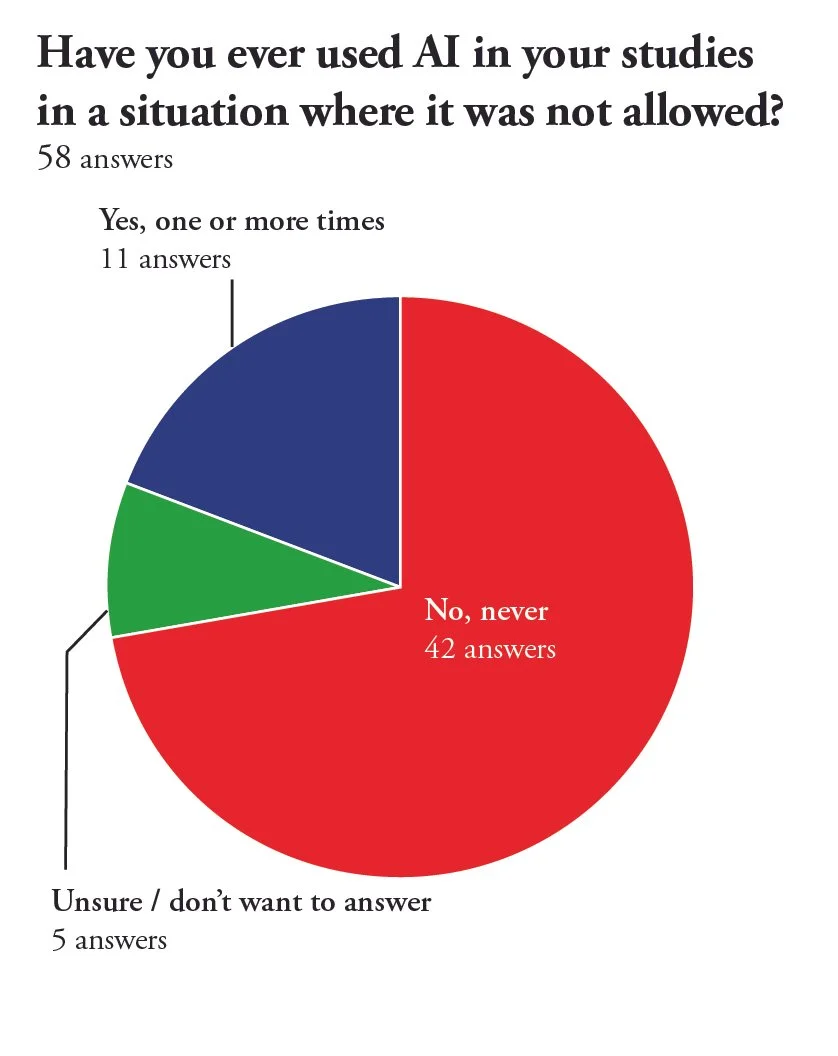
An anonymous survey also lets us ask the more taboo questions. How many of us use AI in academic situations where it isn’t allowed? This could include using it to write essays, solve assignments, or look up answers in cases where it’s clearly against the rules. Here, 19% admit to having “sinned,” while the majority (74%) swear they have never done so. Most manage to resist the temptation to cheat despite how accessible AI has become. Maybe it’s about actually wanting to learn?
“I believe AI in studies can help many, especially with challenges like ADHD or others, by summarizing material or correcting writing mistakes.”
“It’s a good tool to simplify ideas so that the actual material you’re trying to learn becomes easier to manage, but I wouldn’t say it directly helps me learn.”
“I think AI was made available to the public FAR too early, and clear restrictions should have been implemented. It’s already proven that AI use leads to cognitive decline in our society, making us dumber and dumber. One of the first things I learned here at NMBU was source criticism, and that’s also something we lose when we take everything at face value. And this is without even mentioning all the ethical issues.”
What do we think about AI?
Does AI really help us learn more? Most respondents (56%) say yes, either “helps a little” or “helps a lot.” A minority of 27% are negative. Several respondents wrote that AI can simplify and explain the curriculum better than some lecturers or textbooks. When asked about AI in their studies, most said that it is a useful tool but must be clearly regulated. Two extremes also emerged: one group is very positive about AI in studies and believes it’s important for students to be part of the technological development, while the other is very sceptical, fearing that AI prevents independent thinking and learning through solving problems on one’s own. Overall, we appear to be sceptical–positive, seeing AI as a tool for better learning. But will we actually achieve this in practice – or is AI our downfall?
Scary or positive development?
As many as 53% of us usually say thank you to AI after using it. If it ever decides to take over the world, it’s probably smart to be polite, right? But when asked directly whether the rise of AI is scary or positive, most lean toward it being more scary.
Why are we afraid? Many point to the danger of misinformation and relying too much on AI. Concerns include the spread of fake, AI-generated content on social media leading to sexual violence against women, dangerous misinformation, or undermining creative work. Others point out AI’s large carbon footprint. Some fear that we will simply get dumber from using AI, that it will take over, and that people will be expected to use it for everything. Finally, some worry about what it means for the future job market: even if AI creates jobs for highly educated workers, it eliminates many low-income jobs. Could AI create a more elitist society?
“Wish it had never become a thing.”
“Afraid it will reach a point where it’s more unacceptable not to listen to AI, and we’ll trust it more than ourselves.”
“I fear that students won’t actually learn but will rely on AI for most of their studies and won’t truly gain the knowledge they need.”
“SHIT PROGRAM, we don’t need it, and it consumes way too much energy. Fuck AI. Fuck those who develop it. Fuck those who use it uncritically. Grrrrrr.”
“WE ARE FUCKED, ALL OF US. But seriously, when we’re already well on our way to exhausting the Earth’s resources, is it really smart to use AI at the level we do today?? People living near massive data centers are losing their water because it’s being prioritized to cool the damn machines running AI. If you stand for that and also attend Norway’s ‘Environment’ and Life Sciences University, you’re a bit of a hypocrite <3”
“I think it’s a very useful tool, but I’m critical of it being used as a ‘replacement’ for thinking independently.”
“My concern is that it will make the job market more difficult with the degree I’m taking now.”
NMBUs handling
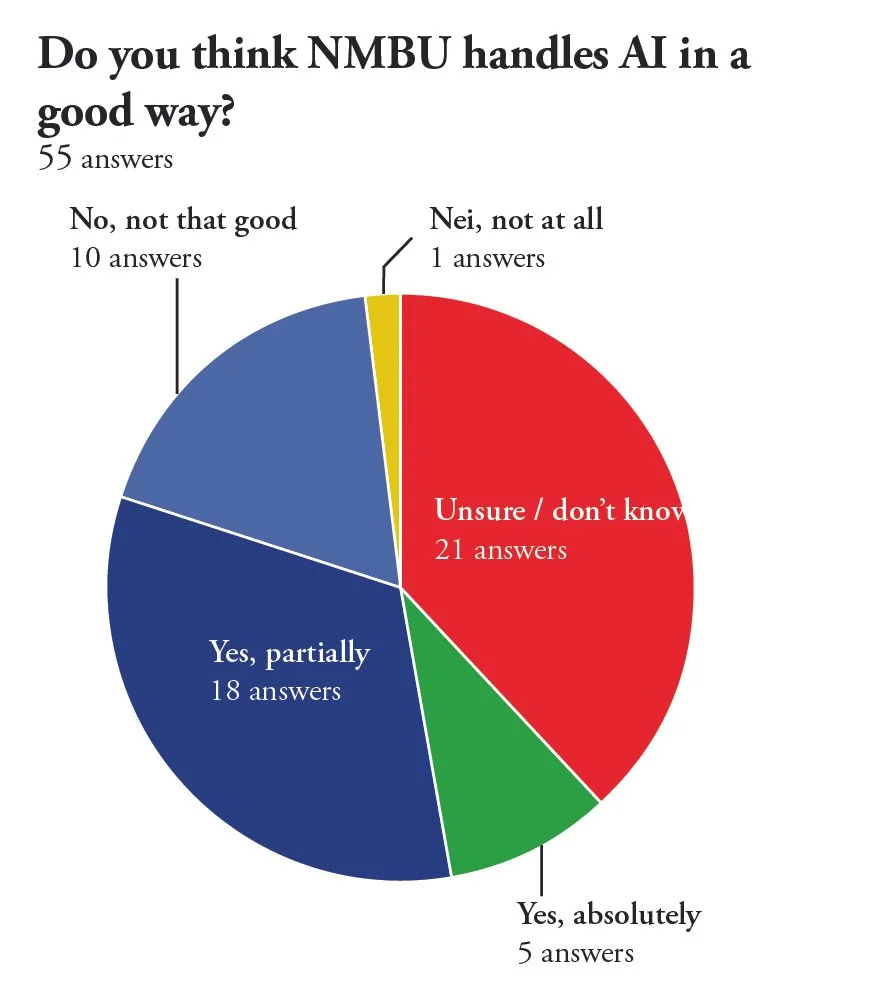
New technology whose full scope is still unknown can feel intimidating, and that’s why it’s especially important that NMBU guides students through this changing landscape. But what do we think about their handling in recent years? Most of us are uncertain… 38% have no clear opinion. Why might this be? Some respondents say the rules are vague, that they miss clearer guidelines in their courses, and that NMBU is lagging behind the times. Others praise NMBU for handling the development well. Some even propose a total ban on AI. So, we are uncertain and divided. The big picture is a bit blurry – perhaps because we don’t feel NMBU has taken a clear stance?
“I think it’s good that NMBU doesn’t use AI detectors, since these are flawed and often give false positives.”
“I think it’s better to embrace it properly rather than being so opposed to it. But good that it’s not allowed on exams.”
“Vague rules, feels like they’re lagging behind. I wish they demanded more from us and regulated AI use more strictly.”
“I haven’t experienced anything negative myself. I think they’re good at keeping up with new trends among students.”
We control AI – not the other way around
At the end of the day, it’s we students who hold the power to decide how we use AI – at least until any potential world domination. No one forces us to use it, nor dictates how we use it. Much like when the internet first arrived, the technology can be used for both wonderful and terrible things.
So, are we really that different from the students we were before AI arrived in 2023? Not necessarily. But one thing is certain: the students at NMBU have thought deeply about AI, and we are at least prepared to face whatever this world-changing technology has in store.