SAMFUNNET - A MONEY MACHINE FUNDED BY THIRSTY STUDENTS?

SAMFUNNET
- A MONEY MACHINE FUNDED BY THIRSTY STUDENTS?
I t’s Friday, and Graskurs Part 2 has just shaken off their performance on stage. People are on the brink of dehydration and flock to the beer taps in the bodega. “A tap beer, please! Member, that’s right.” A service-minded volunteer smile greets you, and a Diggipay terminal is thrown on the counter. The number ‘62’ screams in your squinting eyes. “What the...!”
Journalist: Åsmund Godal
Photographer: William Fredrik Bakke Dahl
Translator: Sofie Palmstrøm
Web distributor: Martha Ingeborg Evensen
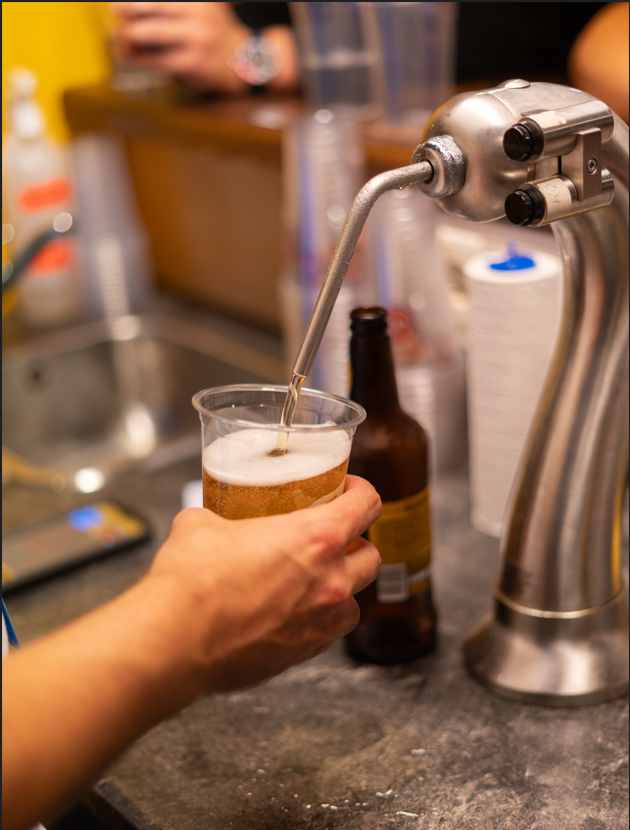
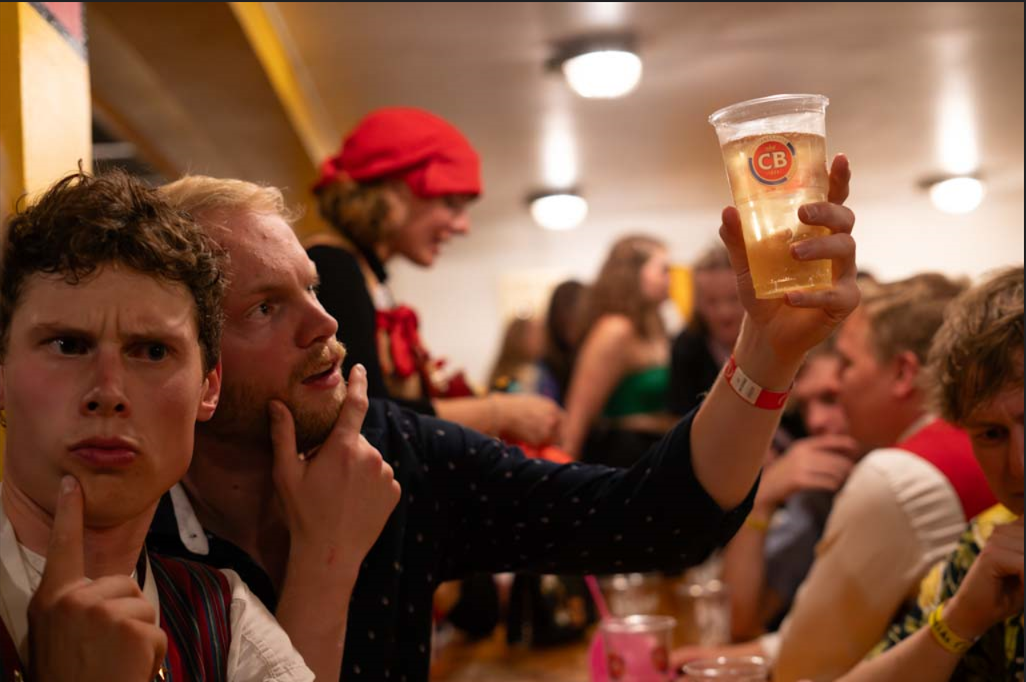
This could have been you. It could have been me. However, it is not. It is a constructed situation. But still, everyone has been to the store and seen that you can get a pint for as little as 25 kroner. There, you don’t need to move barricades or stare at a fire drill board for 8 hours to get a low price. At Samfunnet, beer is sold in 0.4-liter glasses, and you have to shell out 78 kroner for half a liter of beer. That’s over three times as much as in the store!
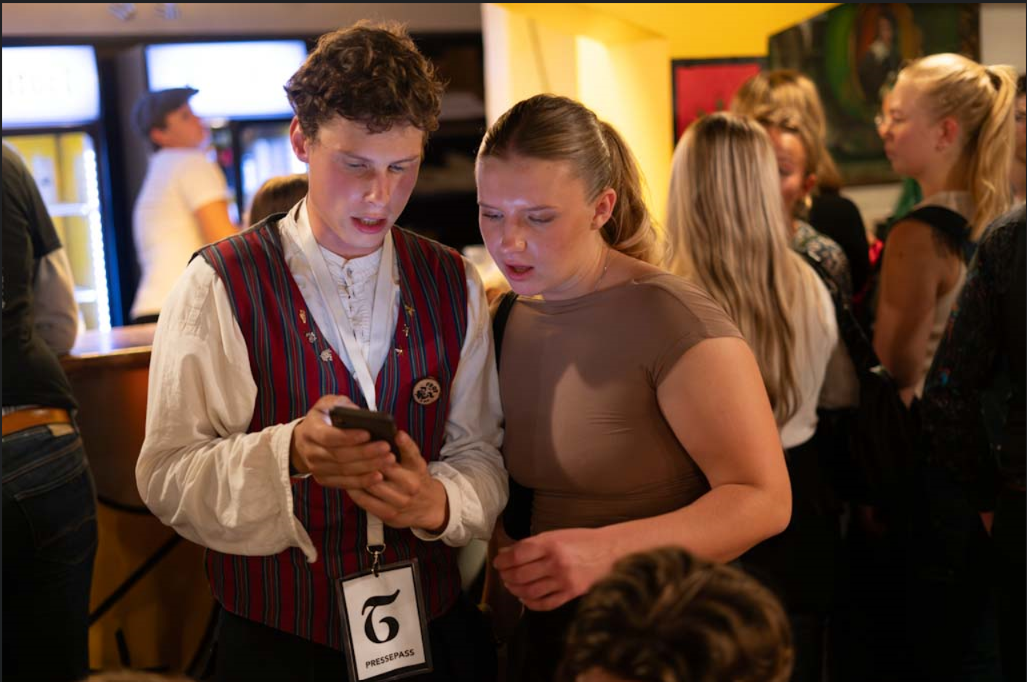
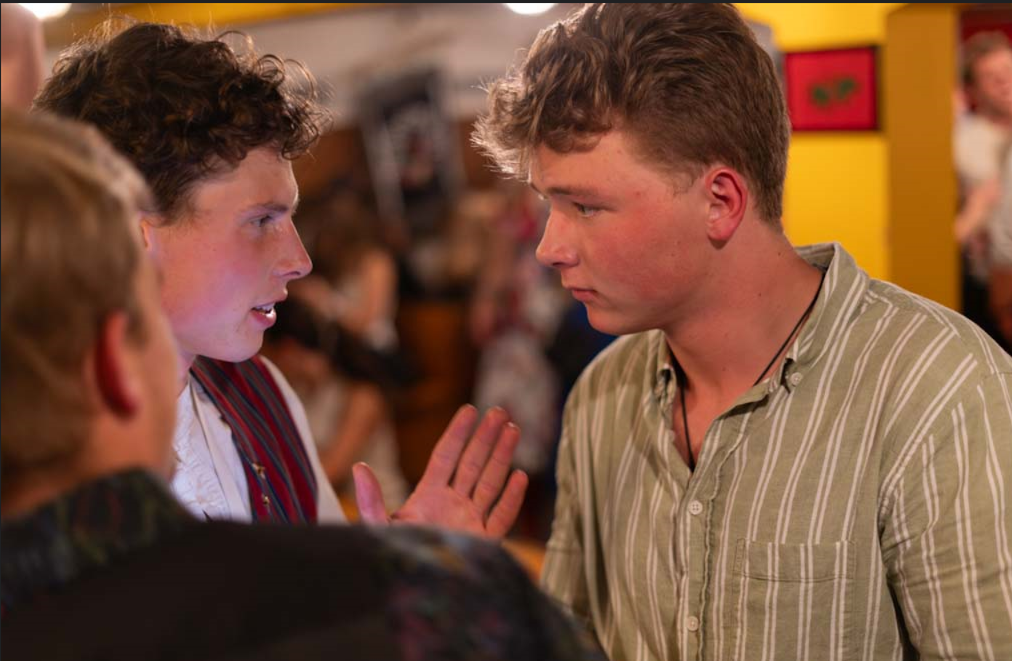
In protest, the fictional person in the situation turns demonstratively away. A furrow appears on their forehead. ‘Something’s not right here,’ they think. Our friend, let’s call them Torve, inquires with people in the queue. Atavan (18, soon 19) thinks it’s “a bit too expensive, honestly.” Andrine (23) agrees and emphasizes that it’s “twice as expensive as in the store, but it’s okay. I understand that Samfunnet needs to make money.” Anders (20) thinks Samfunnet is “fun, but a liiittle too expensive,” and Ida (21) expresses that it’s “expensive, but better than other bars.” Even Gerhard (26) expresses his moderate dissatisfaction with a “not so great, but it could be worse, cheers!” Stian (19, soon 20) and Sindre (25) think the prices are excellent.
Torve sneers at the latter two and marches resolutely out of the venue. They go straight home and go to bed. Tomorrow’s plans to let themselves be beaten by a pounding hangover and bury themselves in the impossible choice between potential membership in various associations are discarded. Instead, the day shall be devoted to thorough investigation. Tomorrow, they will get to the bottom of how greedy conglomerates like Samfunnet can rake in prices of an arm and a leg from desperately thirsty and impoverished students.
Before the birds start chirping, Torve gets up. Breakfast doesn’t consist of a sandwich with liver pâté, pickles, and mayonnaise. It’s beer. From the store. For 25 kroner. Ahhh, nice. A little annoying that that one girl in the collective has to vacuum right now, though. Ouch! Not the feet, please! This is getting ridiculous. They’d rather have a beer at one of Ås’ bars. They probably have reasonable prices.
Arriving at Jojo’s, Torve asks for a beer. 109 kroner. What? Outrageous! Adios, to put it that way. The station café, on the other hand, is pleasant. “How much for a pint? 109?!” Impossible. The bistro? Nope, don’t think so. Charlie’s! WHAT? 115 kroner?! Ås is a terrible nightlife spot. Torve must go to Oslo.
There, they visit no less than 35 nightlife establishments from representative areas in the city, coincidentally the same ones Aftenposten visited in July 2023. The most expensive? 169 kroner. The cheapest? 74! But they don’t serve food there, and the place is, to put it mildly, grim. The average price in Oslo is 120 kroner per pint. It’s far worse than in Ås.
Torve must go out and experience the world. Or, at least an important part of Norwegian students’ world. They report the prices in the following diagram:
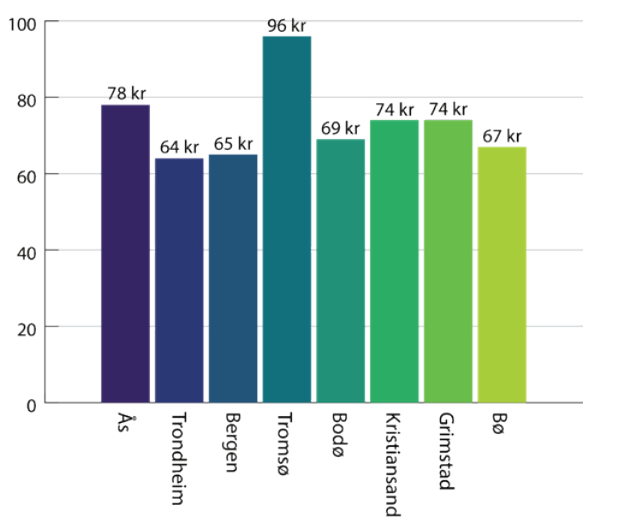
Everywhere, it’s well over twice as expensive as in the store! Quite similar to Samfunnet in Ås. How can that be?
Torve stumbles through the collective door at home and is now so tired that they have a pounding hangover and are haunted by thoughts of which association to join. They are also much poorer than before the Bodega boycott. They lie down and are never seen again. As a more reliable replacement, Tuntreet has interviewed Samfunnet’s financial manager, Ola Walberg Nilssen, who might have some answers.
TT: What’s the price of a beer at Samfunnet today?
Nilssen: We sell 0,4 L on tap for 62 kroner for members, 52 for committee members, and 80 for regular guests. So, the price for half a liter is 78 kr, 66 kr, and 100 kr, respectively.
TT: Why is there a difference in these prices?
Nilssen: This differentiation has been in place for a long time. We want to reward those who take on more responsibility and work more hours for Samfunnet.
TT: What is the percentage of sales in these three groups?
Nilssen: The general distribution for sales is 50 percent members, 30 percent committee, and 20 percent regular guests. This applies to both ticket sales and bar sales.
TT: That means (after a quick calculation) you have an income of 79 kroner per average sold half liter. What is the purchase price?
Nilssen: Lately, we have put a lot of effort into mapping out our purchases. We are satisfied with that. Today, the purchase price is 32,40 kr per half-liter, but it may change depending on the quantity ordered throughout the year. Samfunnet is operated as an entirely voluntary organization, so we don’t pay any salaries. But SiÅs does. Every year, Samfunnet pays approximately 1.1 million kroner to SiÅs for them to hold the liquor license. This includes all administrative costs, billing, finances and accounting, auditing, personnel and employer functions, and other costs related to serving alcohol, such as wages for the liquor controllers. This is called the “serving agreement,” which provides predictability for Samfunnet and gives us greater freedom to improve and develop our services.
TT: So, when you sell beer with a profit of 47 kr per half liter, some of this goes toward paying SiÅs through the “serving agreement”?
Nilssen: Yes. Samfunnet has two main sources of income, ticket sales, and bar sales, followed by smaller items like membership fees and other support. So, you can imagine that in such an old building with a great need for renovation, technical equipment requirements, and so on, the two main sources of income are the main pillars of support for many things.
TT: How much does Samfunnet earn from beverage sales?
Nilssen: You can see the sales numbers here. Beer and spirits are the two most important sales. People generally drink less than before but stronger drinks. We had a fantastic Buddy Week. It was a lot of fun. We generated around 800,000 in total revenue just during the Buddy Week, but obviously with some associated costs.
TT: What is the approximate profit from beverage sales at Samfunnet this year?
Nilssen: According to the reports generated so far this year, we have purchased drinks for around 1 million kroner and sold them for 1.85 million kroner. Adding the cost of the “serving agreement” at 1.1 million, we are still in the negative when it comes to bar sales. We have budgeted for bar sales in 2023 at 2.5 million. This is something we need to achieve to cover the costs associated with serving alcohol.
TT: In Ås’ bars, you can get a half-liter for 109 kroner. You don’t need to pay for membership or put in countless hours of volunteer work. But at these bars, everyone who contributed to getting the beer in the glass gets paid. Waitstaff, cleaners, administration, rent, maintenance. You pay for all of this through the beer. At Samfunnet, most of the work is done by volunteers, yet the regular price per halfliter is 100 kroner. At internal events, SiÅs, which is not run by volunteers, sells halfliters for 95 kroner. Where does the money Samfunnet charges for beer go?
Nilssen: It’s very important for us to make people aware of where the money goes. Bars in Ås are a poor point of comparison. Samfunnet offers a broad range of services that are significantly larger than a pub in Ås or Ski. We operate in several industries, hold concerts, revues, lectures, seminars, quizzes, and run a café. In general, all of Samfunnet’s subunits share a bank account. For example, Tuntreet has a “zero-profit strategy,” where 1000 copies go out about once a month. Printing, delivery, equipment, etc., all cost money. These expenses are covered by the units that generate profits, like the bar.
TT: So, do you have a lot of money saved up?
Nilssen: Yes, Samfunnet has built up a fairly solid equity. With that, we want to reinvest in the house. Everything is used to improve and maintain our services.
TT: But where are the major investments when there is so much money?
Nilssen: It costs a lot to run such an old and large building. For example, there’s a leaking roof in Rosehagen, and a lot is protected and must be done in special ways. And then there’s the Aud.Max. renovation, which we’re waiting to start.
TT: How do you work when you need to set prices?
Nilssen: We’re not out to maximize our income. The focus is to have strict control over costs so that we can provide the best possible offering to our members. We don’t just look at the general price increases in society. What we want is to find the lowest price we can offer in line with an economically sustainable long-term strategy.
TT: How is it possible to buy beer cheaper at Klubben?
Nilssen: Klubben is a wonderful offering, both as a serving and meeting place. We want to contribute to strengthening and promoting it. If we broke even on beer sales during club nights, there would be less room for such services.
TT: Prices are increasing everywhere. Can we expect any price increases at Samfunnet in the future?
Nilssen: I don’t think you should expect a sudden price jump, where suddenly on a Friday, you can only afford one beer. That’s not the intention or strategy. The strategy is to have full control over Samfunnet’s costs and then adjust prices accordingly.
TT: What do you personally think about the price of beer at Samfunnet?
Nilssen: The prices are very competitive and reasonable considering the comprehensive service we have. The bars in Ås can’t compete with it.
Samfunnet is perhaps funded by thirsty students. But also by the efforts of voluntary students! If it’s a money machine, it certainly gives back generously. Let’s hope Torve reads the 6th edition of Tuntreet, so they can find peace of mind. And the next time you’re at the Bodega, you can explain to the servers why the prices are what they are — and gladly pay for what it costs. After all, it’s one of the cheapest bars in the country.